07.07.2026 / APACCCEEC & Partners Successfully Held a Seminar on Registration of F&B and Customs Clearance of Cosmetics for Export to China

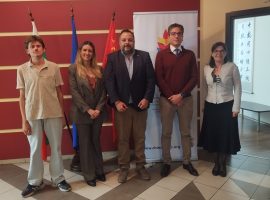
In the period June 30th – July 2nd, 2026, a delegation from Ningbo Customs District, People’s Republic of China, visited Bulgaria. The delegation was headed by Ms. Dang Yingjie, Director-General, Ningbo Customs District. Host of the delegation was the Association for the Promotion of Agricultural Cooperation between China and the Central and Eastern European Countries (APACCCEEC) under the Ministry of Agriculture and Food of the Republic of Bulgaria.
Ningbo Customs District, under the guidance of the General Administration of Customs of the People’s Republic of China (GACC), is responsible for the daily work of the China-CEEC Customs Information Center (CCEECCIC). The current visit of the Chinese delegation from Ningbo Customs District is taking place as a follow-up to the Joint Declaration on cooperation between APACCCEEC and CCEECCIC, which was signed in Sofia on October 17th, 2025.
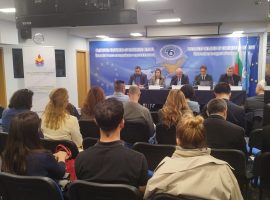
On July 1st, 2026, a Seminar on Registration of F&B and Customs Clearance of Cosmetics for Export to China was held as a joint initiative of APACCCEEC and CCEECCIC. The event took place at TEZ Event Center, Trakia Economic Zone, with APACCCEEC and CCEECCIC as the main organizers.
The seminar was attended by business representatives from the food and beverage, cosmetics, essential oils and food supplements sector, as well as by representatives of chambers of commerce and business associations. The goal of the event was to provide practical information to Bulgarian food and beverage sector manufacturers wishing to export to China, as well as to give to the exporters of cosmetic products some guidance in connection with the customs clearance procedure for such products.
The seminar was moderated by Dr. Momchil Stanishev, Director of APACCCEEC. The event was opened with welcome speeches by:
- Eng. Plamen Panchev, CEO, Trakia Economic Zone;
- Prof. Dr. Svetla Yancheva, Executive Director, Bulgarian Food Safety Agency;
- Ms. Dang Yingjie, Director-General, Ningbo Customs District;
- Mr. Angel Hronev, Chairman, Plovdiv Chamber of Commerce and Industry.
In her opening address, Prof. Dr. Svetla Yancheva, Executive Director of the Bulgarian Food Safety Agency, referred to the Chinese market as a large-scale, dynamic and regulated market. She noted the necessity to make Bulgarian enterprises familiar with the food registration procedures and customs clearance in China. Prof. Dr. Yancheva further outlined the role of the Bulgarian Food Safety Agency as the competent government agency in charge of agri-food chain control and emphasized the Bulgarian Food Safety Agency’s ability to support the businesses with expertise.
Ms. Dang Yingjie, Director-General, Ningbo Customs District, thanked APACCCEEC for the opportunity to hold the current joint event. Ms. Dang emphasized that China is among the countries who are the largest importers of agri-food products, and that the CEE countries are producers of many such products. She referred to Chinese statistical data, according to which China’s imports of agricultural products from the CEE countries amounted to 2.97 billion RMB in 2025. Ms. Dang added that Ningbo Customs District is designated as a main partner in terms of trade within the China-CEEC cooperation initiative, and that the district strives to continuously optimize the process of importing, especially from the CEECs.
During the event, Chinese and Bulgarian speakers delivered presentations. Mr. Liang Qiping, Director, Division of China-CEEC Customs Information Cooperation, Ningbo Customs District, outlined the role and the main functions of the China-CEEC Customs Information Center. The Center was established in 2021 and its daily activity is managed by Ningbo Customs District. The China-CEEC Customs Information Center has several duties, one of which is to create an information hub. To that end, the Center has built a website, where detailed articles and materials are being published. Furthermore, CCEECCIC works on organizing the China-CEEC Dialogue on Customs, Inspection and Quarantine Cooperation and on matters related to the organization of the China-CEEC Expo.
Mr. Liang noted that the website of CCEECCIC publishes materials and presents measures related to quarantine requirements and customs inspection. Furthermore, the web page provides information about statistics connected with trade flows. Mr. Liang also presented the website’s consulting platform, which is an opportunity for website visitors to ask a question and obtain a response. In addition, he introduced a platform developed to provide information about the access status of agricultural products from a specific CEE country to the Chinese market. The platform can be accessed through the following link: https://www.cceeccic.org/d/accessIndex.
Mr. Song Tao, Section Chief of Comprehensive Affairs, Division of Import and Export Food Safety, Ningbo Customs District, delivered a presentation focusing on the GACC registration procedures for overseas food manufacturing enterprises. He specified that the General Administration of Customs of the People’s Republic of China has adopted Order No. 280 – Regulations of the General Administration of Customs of the People’s Republic of China on the Registration and Administration of Overseas Manufacturers of Imported Food, which provide for procedure optimization. The Order was promulgated on October 14th, 2025 and is effective June 1st, 2026. According to Mr. Song Tao, the enterprises which already have registration can equally enjoy the benefits of the new regulations. He summarized the main features of the new provisions, outlined in more detail the types of registration procedures (1. Registration upon official recommendation by the official authority; 2. Self-application for registration, submitted by the enterprises themselves; 3. List-based registration through the official authority) and indicated the conditions, under which these procedures are applicable. Mr. Song Tao further specified the scope of the registration; the conditions, which the enterprises applying for registration need to meet; as well as the steps of the registration process for the three registration procedures. He also described the 17 food categories falling within the Catalogue of Imported Foods Subject to Official Recommended Registration. It was noted during his presentation that the validity term of the registration is 5 years. Part of his presentation focused on the renewal of the registration. Mr. Song stressed that some products are not eligible for automatic registration renewal. He further provided some advice on the steps to be taken in cases where, during the validity period of the registration, a change has occurred in certain circumstances already registered by the foreign enterprise.
Furthermore, Mr. Song Tao demonstrated live how the China Import Food Enterprises Registration system (CIFER), through which an application for registration may be submitted, works in practice. The speaker demonstrated how an account can be created and how data can be entered in the system. The CIFER system can be accessed from the following link: https://cifer.singlewindow.cn
In her presentation, Ms. Joana Peicheva, Head of Department ‘International Collaboration and Projects at the European Coordination’, ‘International Collaboration and Projects’ Directorate, Bulgarian Food Safety Agency (BFSA), presented the agency, its structure, functions and competence, and in particular, the role and functions of the ‘International Collaboration and Projects’ Department. Ms. Peicheva noted that the BFSA has published detailed information in connection with Order No. 280, which can be accessed from the following link:
The information available on the above-mentioned web page also includes details about the requirements for importing to China, about the bilaterally signed export protocols and the bilaterally agreed certificates for export to China. According to Ms. Peicheva, it is important for the business operators planning to complete their GACC registration to check, first and foremost, whether their product falls within the scope of products subject to the official recommendation registration procedure, and if it does – to verify whether the relevant bilateral export protocol has been signed between Bulgaria and China. Ms. Peicheva clarified the steps to be followed within the procedure of ‘registration upon official recommendation by the competent authority’, as for Bulgaria the competent authority is the BFSA. She further noted that within the CIFER system, the BFSA is a user with competent authority user rights and has the opportunity to trace submitted registration applications.
As part of the event, the topic of customs clearance for cosmetics products in China was also addressed with a presentation by Mr. Song Tao. Mr. Song clarified the role of key competent Chinese bodies in the area of cosmetics products and outlined the scope of powers of the National Medical Products Administration (responsible for the administration of the registration and filing for imported cosmetic products) and the GACC (which is responsible for the declaration, inspection and quarantine of imported cosmetics). He provided a legal definition for cosmetics and outlined the classification of cosmetic products in two categories – general and special cosmetics, whereby both categories are subject to a different procedure (filing or registration). The speaker focused on the customs clearance process for imported cosmetic products. He pointed out that for customs clearance purposes, imported cosmetics must possess a special cosmetics registration certificate or a general cosmetics filing number. Mr. Song Tao also provided a summary of the inspections performed by the customs authorities, as well as of the outcomes of the customs clearance procedure, including the cases in which the imported products are found to be conforming or non-conforming.
At the event, the speakers answered questions posed by the representatives of Bulgarian companies.
In addition to the event held on July 1st, the programme of the delegation from Ningbo Customs District also included a visit to APACCCEEC’s Hub for Agricultural and other Products, which is located in Trakia Economic Zone. The delegation had the opportunity to familiarize itself with foods, beverages and cosmetics exhibited in the hub.